

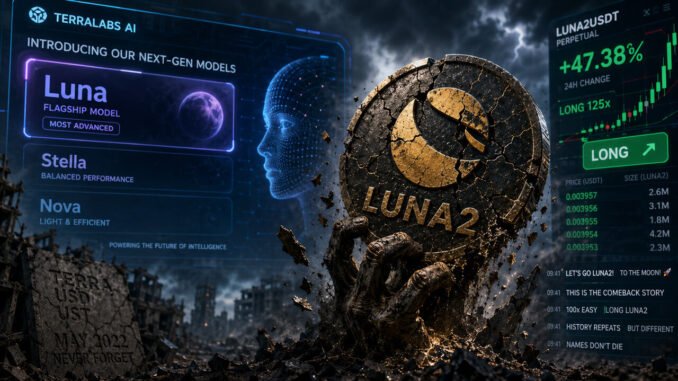

OpenAI introduced GPT-5.6 on June 26 as a limited-preview family of frontier models with three tiers: Sol as the flagship, Terra as the balanced mid-range option, and Luna as the fast, low-cost tier.
OpenAI says Sol performs competitively with Anthropic’s Mythos Preview on ExploitBench using roughly 33% of the output tokens, at $5 per million input tokens and $30 per million output tokens.
The rollout is initially restricted to a small group of vetted partners via API and Codex, at the US government’s request, while OpenAI works through cybersecurity and release-process questions regarding the model’s capabilities in biology, coding, and offensive cybersecurity.
Despite all this background, crypto traders found a different catalyst in the product names.
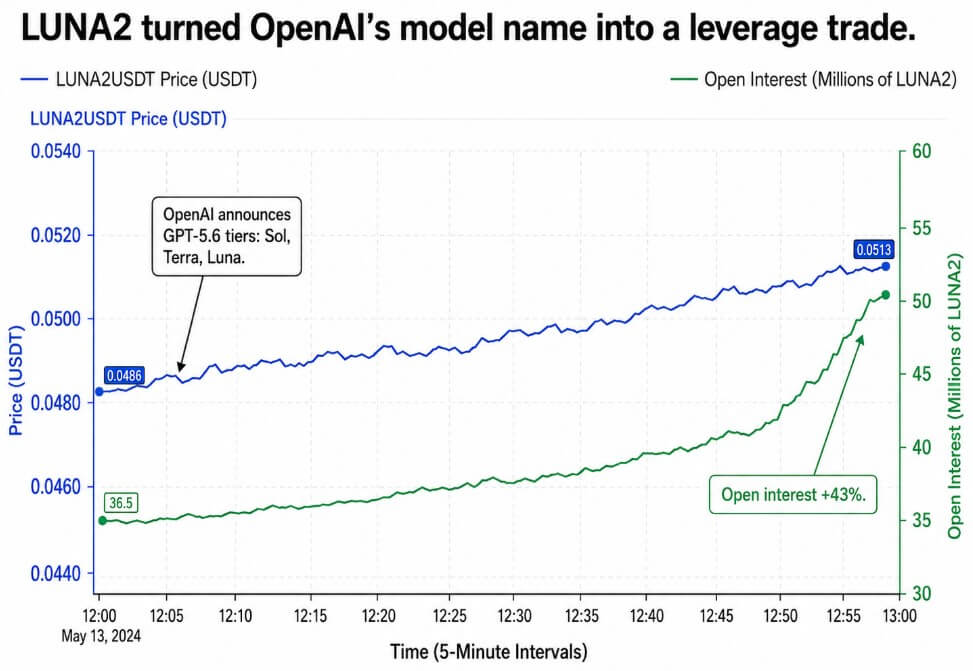
Within minutes of the announcement, LUNA2 futures on Binance moved, with the price on the LUNA2USDT 5-minute chart climbing from around $0.0486 to a high of $0.0513.
Open interest jumped from approximately 36.5 million LUNA2 to 52.3 million LUNA2, a 43% expansion in positioning, while funding turned positive at 0.01%.
The Coinbase premium panel showed no symbol match, placing the action entirely in crypto-native perps venues, with US spot markets uninvolved.
LUNA2 has a market cap near $36 million and a 24-hour trading volume of around $8.5 million, thin enough that attention and borrowed capital can move it before fundamentals have time to matter.
The token is a post-collapse Terra governance token whose name rhymes with one of OpenAI’s new GPT tiers, and the trade ran entirely on that overlap.
What traders were buying
Terra/Luna collapsed in three days in May 2022, wiping out roughly $50 billion in valuation.
The SEC later charged Terraform Labs and Do Kwon with what it described as a multi-billion-dollar crypto-asset securities fraud tied to UST, LUNA, and related assets.
Terra 2.0 survived as a residual post-collapse blockchain, with LUNA2 as its governance token, still listed on dozens of markets and still carrying the cultural weight of one of crypto’s most catastrophic failures.
When OpenAI named its cheapest model tier “Luna,” traders bet that everyone else would react to the word before the joke expired. Enough bots, headline scanners, chart chasers, and social accounts would see “Luna” that the ticker could move on name recognition alone, and a 5-minute perp position costs nothing to hold while that cascade forms.
Open interest expanding 43% faster than price confirms the trade was leveraged positioning around anticipated attention rather than spot accumulation driven by new information about LUNA2’s fundamentals.
Crypto researchers call this semantic arbitrage: traders buy the expectation that a recognizable word will move through crypto’s attention economy fast enough to generate a return before the cascade collapses.
LUNA2 had all of them the moment OpenAI said “Luna” in a press release.
The pattern behind the joke
The same mechanism has been running for years, with 2025 and 2026 producing its most industrialized form yet. TRUMP surged more than 50% in April 2025 after the project announced that top holders would be invited to an exclusive gala.
PENGUIN reportedly jumped roughly 564% after a viral White House post showed President Donald Trump alongside a penguin. GORK surged more than 520% after Elon Musk posted the single word “Gork” on X, with no utility or project behind it beyond the post itself.
A 2026 academic paper on Solana memecoins found that launchpads had processed over 40,000 migrated tokens and more than 180 million post-migration transactions, a figure that reflects how thoroughly the infrastructure for converting words into markets has been industrialized.
TRUMP trades on political access, PENGUIN on presidential adjacency, GORK on Musk keyword proximity, and LUNA2 on OpenAI’s model-naming collision with a collapsed blockchain.
Markets form around the speed at which everyone realizes everyone else saw the same word. A token only needs enough cultural surface area with the catalyst to trigger a short-lived attention cascade and become tradable.
In this case, crypto traders extracted a two-hour perp trade from the product naming and moved on.
Token / tradeCatalystWhat traders actually boughtWhy it fits the patternLUNA2OpenAI named a GPT-5.6 tier “Luna”Name collision with Terra/LunaA collapsed blockchain ticker became an AI-announcement tradeTRUMPTop-holder gala accessPolitical proximity and statusThe token traded attention, access, and spectaclePENGUINViral White House penguin postKeyword adjacencyTraders bought the meme before meaning formedGORKElon Musk posted “Gork”Musk keyword reflexNo utility was needed; the word itself became the catalystSolana memecoinsLaunchpad-driven token issuanceIndustrialized meme creationInfrastructure now turns cultural fragments into tradable assets
The arbitrage has a shelf life
In the bull case for semantic arbitrage as a durable crypto trade, the LUNA2 move becomes a template.
Traders begin systematically screening AI model names, celebrity product launches, political speeches, and viral cultural moments for ticker-shaped collisions with low-float tokens carrying derivatives access.
The trade professionalizes into dedicated desks that monitor real-time announcements for name overlaps, build positions before social velocity peaks, and exit before funding rates turn punitive.
Any culturally recognizable word attached to a thin-liquidity token with perp access becomes a temporary market structure.
The Solana launchpad data already show that the supply side is industrialized, and the demand side follows once the edge becomes legible enough to systematize.
In the bear case, the LUNA2 move is a one-session oddity that tightens its own edge. Exchanges raise margin requirements on tokens that show sudden OI spikes unconnected to fundamentals.
Funding costs in crowded semantic trades climb quickly enough to punish late entrants. The early movers extract the spread; everyone who follows chases a chart that has already priced the joke.
Copycat trades on the next AI model name collision get squeezed before the cascade forms because too many traders have learned the playbook and positioned ahead of the catalyst, even when it lands.
The arbitrage compresses to the point where only the fastest execution infrastructure can capture it.
ScenarioWhat happens nextWho winsWho losesMarket implicationBull caseTraders systematize name-collision trades across AI, politics, celebrities, and viral postsFast desks, bots, early scannersLate retail chasersCultural keywords become a formal trading signalBase caseThese trades keep appearing, but most last minutes or hoursEarly entrantsAnyone holding after the joke peaksSemantic trades become short-lived attention rentalsBear caseThe edge gets crowded and funding turns punitive fasterExchanges, market makersMomentum tradersThe strategy self-compresses as everyone learns the playbookBlack swanA crowded semantic trade triggers liquidations or exchange interventionShorts or early exitsLeveraged longsTicker collisions become a recognized perps-market risk
Across both cases, crypto runs a market layer on cultural association faster than it runs on fundamental value. OpenAI set out to establish a frontier-AI benchmark and win a model war against Mythos.
In the time it took the announcement to circulate, crypto traders had already opened, ridden, and begun unwinding a leveraged bet on a word.

Be the first to comment